Skip to content
  • Categories
  • Recent
  • Tags
  • Popular
  • Users
  • Groups
Skins
  • Light
  • Brite
  • Cerulean
  • Cosmo
  • Flatly
  • Journal
  • Litera
  • Lumen
  • Lux
  • Materia
  • Minty
  • Morph
  • Pulse
  • Sandstone
  • Simplex
  • Sketchy
  • Spacelab
  • United
  • Yeti
  • Zephyr
  • Dark
  • Cyborg
  • Darkly
  • Quartz
  • Slate
  • Solar
  • Superhero
  • Vapor

  • Default (No Skin)
  • No Skin
Collapse
WIBIMMERS logo

WIBIMMERS

  1. Home
  2. General Discussion
  3. General Technical
  4. Ceramic Coated Manifold Data

Ceramic Coated Manifold Data

Scheduled Pinned Locked Moved General Technical
13 Posts 8 Posters 0 Views 1 Watching
  • Oldest to Newest
  • Newest to Oldest
  • Most Votes
Reply
  • Reply as topic
Log in to reply
This topic has been deleted. Only users with topic management privileges can see it.
  • B
    B
    B C
    wrote on last edited by
    #1

    Along with powdercoating I have started doing thermal barrier ceramic coatings and will soon begin high-emissivity coatings.

    The basic theory and application of ceramic coatings is to reduce the amount of energy that escapes through the walls of the header/manifold pipes in order to keep exhaust gas velocity high for exhaust scavenging during overlap on NA engines and to lower your spool rpm on a turbo engine by increasing the energy hitting the turbine.

    I will spare you all the boredom of the test procedure and setup but you are welcome to ask any questions you may have if you would like to know more.

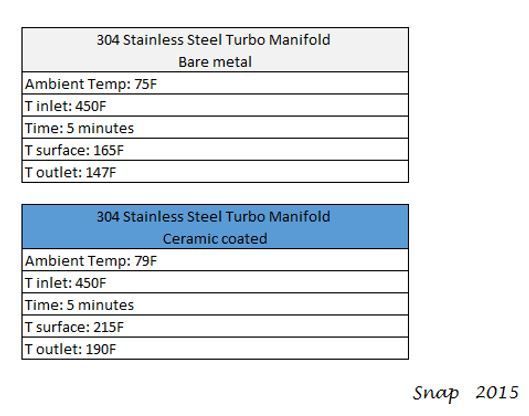
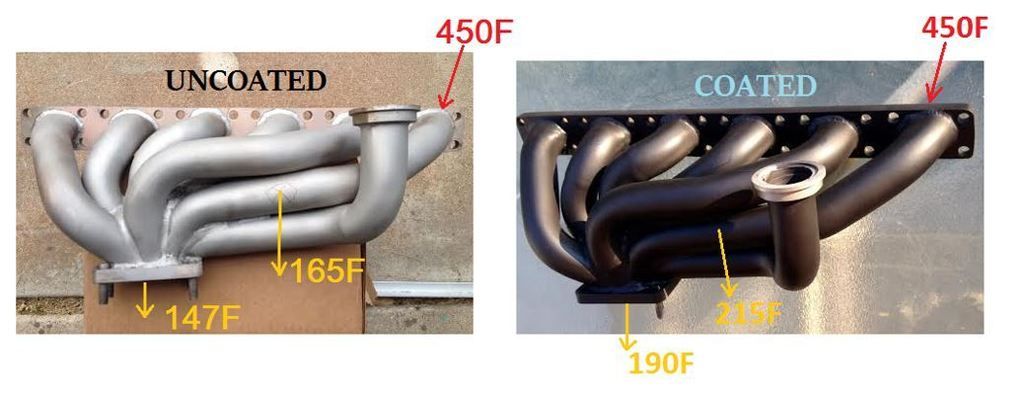
    Test data for uncoated vs coated is shown below with a 450F input temperature in the port for cylinder 1. Surface temperature @ mid span of tube 1 and internal temperature at the outlet were recorded.
    tabulated%20datazpsage5ydnz.jpgcoated%20uncoated%20comparisonzpsu2cpfm

    As expected, more heat(energy) made it to the outlet with the ceramic coating.

    What wasn't expected was more heat on the surface of the tube.

    With the uncoated manifold, the heat was conducted throughout the entire manifold quite uniformly even though the 450F was only being introduced into the tube for cylinder 1. The energy that should be going through the outlet was being equally dispersed throughout the steel and the ambient air both inside and outside of the tubes caused the manifold to act like a large radiator. The tube for cylinder 6, despite being the farthest away from the heat source, was very hot to the touch.

    With the coated manifold, the thermal conductivity through the manifold is significantly reduced which keeps much more of the heat(energy) inside the tube for cylinder 1. The energy that used to be conducting freely throughout the manifold was staying in the tube for cylinder 1. With more energy staying in that 1 tube, naturally the outlet temp and the surface temp are going to be higher since the energy concentration is higher.

    If the experiment was conducted with heat sources in all 6 cylinders I would expect the uncoated manifold to become thermally saturated and have a much higher surface temperature than the coated manifold.

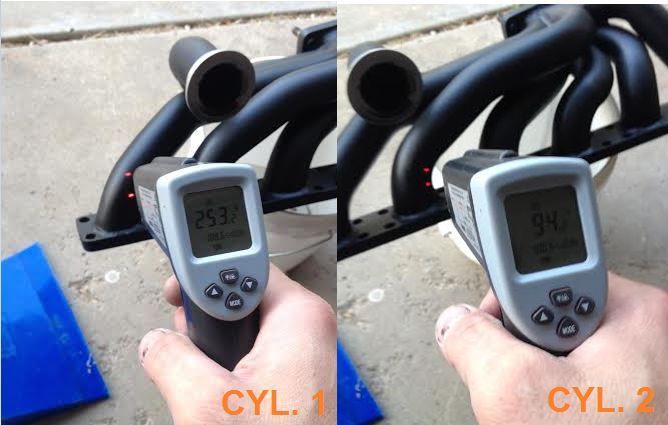
    Evidence of the improved energy containment within the tube is shown below.
    cyl%201%20cyl%202%20compzpszj2zayog.jpg

    A minute after removing heat, the surface temp of tube 1 was 253F. Cyl 6 and the wastegate tube (which contacts tube 1) were very close to ambient. Interestingly enough tube 2 conducted very little heat from tube through the flange or collector as it was only 94F.

    Cliffs notes: let me give you horsepower

    1 Reply Last reply
    3
    • DrLeadFootD
      DrLeadFootD
      DrLeadFoot
      wrote on last edited by
      #2

      Great info!

      Sent from my SM-G900V using Tapatalk

      15924991875a64c599885m.jpg

           @DrLeadFoot

      1 Reply Last reply
      0
      • Bassboy3313B
        Bassboy3313B
        Bassboy3313
        wrote on last edited by
        #3

        ^^^+1

        CHECK OUT >>> RAGE DRIFT DESIGNS <<< FOR DECALS AND MORE!

        1 Reply Last reply
        0
        • TehRaydarloverT
          TehRaydarloverT
          TehRaydarlover
          wrote on last edited by
          #4

          How durable is the coating? Think you could use it on the exhaust runner and combustion chamber? Should help with detonation in turbo application. Keeping the heat out of the m20 head should also help keep it from cracking.

          Untitled1zps3446a42f.png

          1 Reply Last reply
          0
          • B
            B
            B C
            wrote on last edited by
            #5

            This particular coating is used on pistons, combustion chambers, valve faces, turbo housings, turbine blades (with re-balancing im sure) etc. it holds up to shockwaves and heat fine but abrasion can chip it.

            1 Reply Last reply
            0
            • CMartC
              CMartC
              CMart
              wrote on last edited by
              #6

              Very nice.

              How much would this cost for a set of V8 manifolds?

              Excursion 7.3
              E30 LS1

              1 Reply Last reply
              0
              • GunMetalGreyG
                GunMetalGreyG
                GunMetalGrey
                wrote on last edited by
                #7

                Very nice! 
                I am also surprised to see the increase in surface temp after coating! 
                I assume these are coated inside and out?

                ...

                1 Reply Last reply
                0
                • B
                  B
                  B C
                  wrote on last edited by
                  #8

                  Yep inside and out as much as possible

                  1 Reply Last reply
                  1
                  • A
                    A
                    andrewwynn
                    wrote on last edited by
                    #9

                    iR thermometer doesn't work on "shiny" did you take actual measurements with a surface probe? Without knowing the "e" of the surface and dialing the IR to that e value you can't directly compare especially when the coating is changing the e on purpose. I've temp'd metal pipe that is 300f but reads 120 because it's averaging in the reflection of the room.

                    The coating looks awesome. How tough is it and could it be used on wheels?

                    Sent from my awrPhone using Tapatalk

                    1 Reply Last reply
                    0
                    • patsbimmer1P
                      patsbimmer1P
                      patsbimmer1
                      wrote on last edited by
                      #10

                      andrewwynn said:

                      iR thermometer doesn't work on "shiny" did you take actual measurements with a surface probe? Without knowing the "e" of the surface and dialing the IR to that e value you can't directly compare especially when the coating is changing the e on purpose. I've temp'd metal pipe that is 300f but reads 120 because it's averaging in the reflection of the room. The coating looks awesome. How tough is it and could it be used on wheels? Sent from my awrPhone using Tapatalk

                      That's interesting to know.  I'e been using an IR thermometer to measure rotor temps for years now.  I think for his purpose right now he can still measure with an IR therm and gather results based on variances.  

                      Why would you want to use this on wheels?

                      2011 e90 M3 - DCT, Borla exhaust, BMW Performance Black Grille, ECS Painted Corners, Ziza Angel Eyes

                      07 335i Stella - sport package, BMS DCI, zhp knob, TMS cf parking brake lever, VRSF downpipes, MHD tune, H&R race springs, other stuff *SOLD*

                      97 328i Lola - sport package, m50 intake manifold, m50 manifold.com install kit, custom CAI, K&N filter, Borla exhaust, FK silverline coilovers, 25.5mm front sway bar, Powerflex front sway bushings, Turner Radiator, fan delete *sold*
                      95 325is *sold*
                      93 nissan 240sx KA-T *sold*

                      BMWCCA #473306

                      Instagram @patsbimmer1

                      AKA- HALLWAY PAT

                      "burnouts bring babes and babes dont have time for bushings" - Kaiser Rolls

                      1 Reply Last reply
                      0
                      • A
                        A
                        andrewwynn
                        wrote on last edited by
                        #11

                        If the coating is harder or has a satin or matte finish that is unique it would be cool. Also maybe it adheres better for a more reliable rim seal

                        Sent from my awrPhone using Tapatalk

                        1 Reply Last reply
                        0
                        • B
                          B
                          B C
                          wrote on last edited by
                          #12

                          Hi Andrew, thanks for the info. I will do some research and play with emissivity values that may correlate to higher accuracy results on my next experiment. The coating is more durable than I anticipated it to be, though I like to put a generous surface profile on the parts I prep. It can flake off if it gets chipped. It is a lot like the green coating on brake hard lines.

                          I dont see why it wouldnt work on wheels although a rock chip would make it vulnerable to flaking moreso than a more flexible enamel type paint

                          1 Reply Last reply
                          0
                          • A
                            A
                            andrewwynn
                            wrote on last edited by
                            #13

                            I've been using IR thermometers for years. You just plain can't measure the temp of a mirror surface for and example. You will be measuring the temp of the item in the reflection. To measure a soda can for example you have to put on a piece of tape. Same for ductwork. A surface probe thermocouple would be the accurate way to measure but an internal probe into some thermally conductive goo of some type would be a decent makeshift. Only trial n error you can get an accurate e value for the different surfaces but once determined should work well. High temp tape should work well

                            Sent from my awrPhone using Tapatalk

                            1 Reply Last reply
                            1

                            Hello! It looks like you're interested in this conversation, but you don't have an account yet.

                            Getting fed up of having to scroll through the same posts each visit? When you register for an account, you'll always come back to exactly where you were before, and choose to be notified of new replies (either via email, or push notification). You'll also be able to save bookmarks and upvote posts to show your appreciation to other community members.

                            With your input, this post could be even better 💗

                            Register Login
                            Reply
                            • Reply as topic
                            Log in to reply
                            • Oldest to Newest
                            • Newest to Oldest
                            • Most Votes


                            • Login

                            • Don't have an account? Register

                            • Login or register to search.
                            Powered by NodeBB Contributors
                            • First post
                              Last post
                            0
                            • Categories
                            • Recent
                            • Tags
                            • Popular
                            • Users
                            • Groups