
E30 M52
-
The rattling is just from open headers. I had the exhaust fall off of my Corolla (maybe from jumping curbs) and it would rattle your teeth out with it open after the cat.
Also these engines shine the most ABOVE 3000 RPM. You will like it once you get used to it. I think it is less obvious on OBD2 but on OBD1 the vanos point around 3500RPM is like switching on noticeably more HP.
Edit: Also you might have had a bubble of air in the cooling system, I usually hold the revs around 2000 when bleeding to get some velocity of coolant to carry the air into the radiator to come out the bleed hose.
Yeah, it was tough to bleed the system in suburbia when its idling like a top fuel dragster. When I pick the car up I will come armed with a temp gun, gallon of coolant, and bleeding supplies and do it in the parking lot.
I think what you may have been dealing with in terms of "stale" power is the fact that you were used to boost building without increasing throttle input.
Now you'll need to lean on the throttle more to get more out of it, which will be a change of habit.I'm glad to hear things are going alright!
Yeah that is true, your initial throttle input to accelerate gradually gets an added dose of power once the turbina wakes up.
Im feeling a little more excited about things today. Yesterday I had plenty of chaos unrelated to the E30 that contributed to the anxiety of the maiden voyage. I have to be happy that it idles well and doesnt leak oil. Here's to hoping a simple re-bleed tonight will have me running cool for years to come
-
Here's to hoping a simple re-bleed tonight will have me running cool for years to come

-
I let my car idle for 15-20 minutes, it got up to temperature, I opened the screw a few times. I had just half of a baby's breath of air puff out and that was all I could get. As far as i'm concerned its bled, but we will see for sure once I start driving. Definitely easier than bleeding an M42 radiator on an M20
when you said this in the other thread I was skeptical. the way i go about it is jacking the drivers corner up, cracking the expansion tank cap, and massaging the lower rad hose. its fairly obvious if there is air trapped - you can hear the hose gurgle when you squeeze it and you can see the coolant with air bubbles coming through the small overflow line from the radiator to the expansion tank. you can also feel the temp difference across the radiator until the air is out.
Dan

-
Also these engines shine the most ABOVE 3000 RPM. You will like it once you get used to it.
This! Vanos starts switching over around 3000rpm, above that is where its at!
Edit: Also railing it through corners, that's really where it's at
-
Stock Toyota Sienna radiator and expansion tank
jk
Upgraded Aluminum M20 radiator from ECS Tuning and a new Stock late model E30 expansion tank with a new 200kpa E39 528i pressure cap
That should self bleed any remaining bubbles, just drive it and make keep checking the tank until it steadies out to make sure it doesn't get low. That is an ideal setup in my opinion. You don't need the cap off once most of the air is out. You can see the bubbles coming from the metal tube going to the bottom of the expansion tank if there are any. The tube prevents air from going back to the radiator when the car is shut off.
-
https://www.amazon.com/UView-550000-Airlift-Cooling-Checker/dp/B0002SRH5G#customerReviews
One of my absolute favorite tools for putting fresh coolant in any vehicle. If your unfamiliar with what this is, It uses vacuum to suck the coolant into the cooling system ( No air bubbles, no dicking around trying to raise the front of the car or trying to bleed the system). It's super fast (literally 2 minutes and your done) and it also works as a good tool to check for any cooling system leaks before putting any coolant in. I have one you are more then welcome to use if you'd like.
-
https://www.amazon.com/UView-550000-Airlift-Cooling-Checker/dp/B0002SRH5G#customerReviews
One of my absolute favorite tools for putting fresh coolant in any vehicle. If your unfamiliar with what this is, It uses vacuum to suck the coolant into the cooling system ( No air bubbles, no dicking around trying to raise the front of the car or trying to bleed the system). It's super fast (literally 2 minutes and your done) and it also works as a good tool to check for any cooling system leaks before putting any coolant in. I have one you are more then welcome to use if you'd like.
We had one of these or something similar at the shop I used to work at, it was fantastic. I was able to use it on my e36 at one point and it made filling and bleeding it a 5 minute process.
-
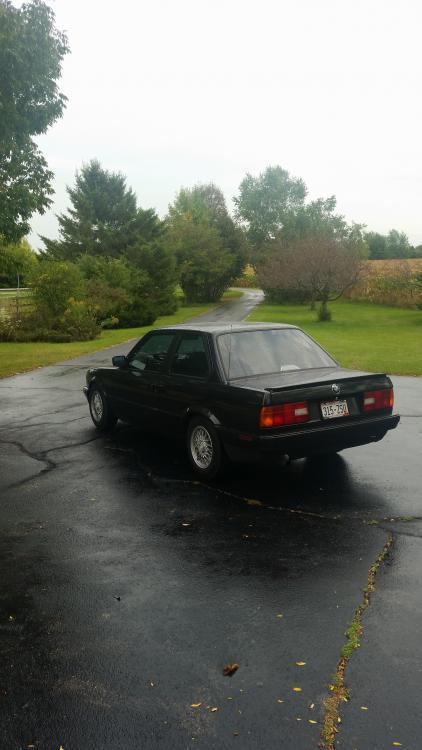
Picked the car up. The exhaust is louder than Id like it to be but its sufficient for suburbia.
It turns out the lower radiator hose wasnt even secured and the hose clamp was dangling. So I secured that and
I went down the road from the exhaust place to NAPA to reassess the coolant bleeding situation for the rest of the trip home. That way if i needed any more tools or supplies than I was already carrying, id be okay.
I did get some air out, however, when I went a few blocks down the road, the temp climbed to 3/4 again. So I kept pulling over and trying to bleed it more.
I live my life a quarter mile at a time I guess....
The stumble that i thought I felt yesterday occurred a little bit but only when revving in neutral while bleeding, and the coolant was looking a little dirty. So I started down the familiar road of coming to terms with the chance that the head gasket was bad.
I checked the dipstick for milkshake.... nope, looks good. Then checked under the oil cap.....

Uh....
The current situation is still very much point/counterpoint though.
Point: the car appears to be running hot (according to the gauge)
Counterpoint: The gauge may be glitchy
Point: theres milkshake under the oil cap
Counterpoint: But it could be condensation from the oil sitting for the last 6 months, and the dipstick was clean
Point: The coolant got a little dirty
Counterpoint: The inside of the block is full of rust and scale im sure from sitting dry for at least a year.
Point: The engine stumbled a bit
Counterpoint: The gas is about 2 years old, the maf or tps may not be perfect, and the ECU may not have had a fair chance to establish adaptations
Point: its obvious the engine has run hot in the past from all the stripped cam bearing holes I experiences
Counterpoint: its also obvious someone has been in there before and perhaps there is a fresh head gasket on the engine. The Compression numbers I tested A few months ago were stellar
My next stop was the gas station. It took 8 gallons of fresh 93 octane to help dillute te old stuff. I continued to limp home and watch the temp gauge get to 3/4, pulled it in the driveway and got bummed out that things arent going well so far.
Im right back where I was a year ago faced with the possibility of a broken car and looking at another $1000 and many weekends of my free time to get things squared away again.
-
I pulled the batt cable to reset adaptations and went out for another 3 mile drive after yet another bleeding attempt. The temperature once again went to 3/4. i switched the car off then back on again.....
Aha!
Just like yesterday once i turned the car off and on again the needle snapped back to just under 1/2 and stayed there. I started realizing the gauge may actually be lying to me and made my way home to start connecting the VDO gauges I installed.

It was running top notch, no sign of any issues, it seems like the reset and the fresh gas are showing a difference already
I have the wires run for the VDO gauges but do not have the sensors installed. I have been waiting to order an oil distribution block and also a good enough reason to pull the thermostat housing so i could drill and tap it for the VDO sending unit.
It was my intention to keep the stock temp gauge in the cluster function and use the vdo as a backup/sanity check but I need answers and cant trust the stock one anymore.
I removed the stock temp sender and installed the VDO one in its place without removing the intake manifold. Do I win a prize?
Im actually feeling quite optimistic now.
Tomorrow I will give it a long drive and see for sure what the temperature is. As far as things are going right now, it seems to be running perfect and its just the temp. gauge reading that is an issue.
Here is a video of the gauge reading climbing then reverting back to a better reading after shutting the car off.
And a video of the engine running ever so smooth and nice.
Please let this be just a lying gauge and not another head gasket....
-

Uh....
When it's cold out and after shorter drives the underside of the oil cap on my M3 looks like exactly this, and it goes away after a longer drive or frequent driving. My guess is it's just condensation and a longer drive should eliminate it.
My next stop was the gas station. It took 8 gallons of fresh 93 octane to help dillute te old stuff. I continued to limp home and watch the temp gauge get to 3/4, pulled it in the driveway and got bummed out that things arent going well so far.
After my car sat for 2 years, the gas in the tank smelled pretty terrible and the car ran ok but definitely not smoothly. I had maybe 3/4 of a tank so I ran it down and then diluted it with fresh gas, ran so much better. I'd guess that your stumble is at least partially a bad gas problem.
As far as the temp gauge, have you checked the grounding nut on the back? If it's vibrated loose it can make the gauge behave weirdly, it looks like it's bouncing around a little bit and that's nearly exactly how my e30 behaved when I bought it. The grounding nut had completely fallen off, tightening it back down fixed it completely.
Another possibility, and this is just me tossing ideas around: Where do you have the e30 temp sensor reading from on the engine? I am running an 80C (176F) thermostat in the M3, and the ECU typically reads the coolant temps in the head around 188-190 (freeway cruising or cooling fan on) and up to 195F sitting at a stoplight for a few minutes. I would imagine that with a 92C (197F) thermostat, your coolant temps (assuming you're getting the numbers from a similar location to stock) would be around 20F higher, so maybe in the 215F range. I couldn't find numbers on what the stock m20 runs at, but I'd imagine is significantly lower since the stock thermostat is an 80C and some people even run 71C. With an m20 and a 71C thermostat, some people on r3v say their gauge sits at the 1/4 mark, and with my m42 and it's 88C thermostat the gauge sits just over the 1/2 mark at operating temp. Its entirely possible that somewhere around the 3/4 is just where it wants to sit with that thermostat/engine? I would definitely hook up the VDO gauge for a sanity check/backup though.
Also that idle sound fantastic!
-
Thanks for the reassurance. The way my car is presenting itself to me is a lot like consulting Dr. Google when you dont feel good and everything you read is cancer, AIDS, or heart disease, but actually you just have a cold. There are some overlapping symptoms, but im optimistic that everything is fine. Tonight I will go out for a proper shakedown run with the VDO connected and should be able to confirm that everything is fine and ready for daily driver status.
-
So what you're saying is we should definitely expect to see this beast at Cars and Coffee on Saturday !

2011 E92 M3 6MT ZCP - ESS 625 supercharged
2007 Z4MR
2003 E39 M5
2002 E46 M3
2021 X5 40i -
Condensation on the oil cap is not abnormal. Get the real gauge hooked up before worrying, the stock one is useless. Was the engine from a wrecked car or unknown? If you know it was from a wrecked car I consider that a good thing because it was likely driving fine when an accident happened.








Hello! It looks like you're interested in this conversation, but you don't have an account yet.
Getting fed up of having to scroll through the same posts each visit? When you register for an account, you'll always come back to exactly where you were before, and choose to be notified of new replies (either via email, or push notification). You'll also be able to save bookmarks and upvote posts to show your appreciation to other community members.
With your input, this post could be even better 💗
Register Login